
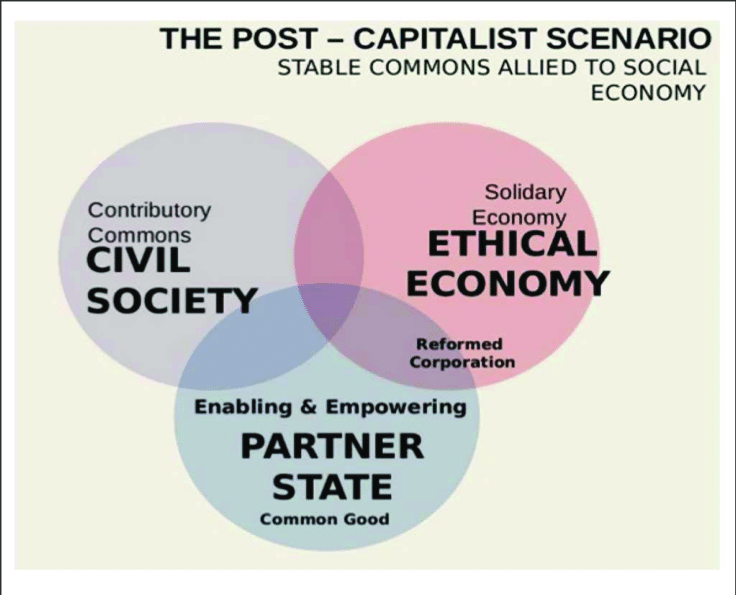
The role of charitable foundations in a post-capitalist era is a complex and speculative topic, as we are still largely within a capitalist global system. However, imagining a post-capitalist future—where the dominant economic structures shift away from market-driven accumulation of capital toward systems based on equity, sustainability, and collective well-being—allows us to explore how charitable foundations might evolve or be reimagined.
Here’s an analysis of their potential roles:
1. From Alleviation to Transformation
In capitalism, many charitable foundations focus on alleviating symptoms of inequality—such as poverty, poor health care, and education gaps—often without addressing root causes like wealth concentration or exploitative labor practices.
In a post-capitalist context, foundations may shift toward systemic transformation, supporting initiatives that build alternative economies: cooperative enterprises, community land trusts, universal basic services, and decentralized governance models.
Example: Foundations could fund pilot programs for resource-based or needs-based distribution systems, or support research into non-market mechanisms for allocating goods and services.
2. Stewards of Common Wealth
As capitalism recedes, assets previously concentrated in private hands (including foundation endowments) may be redefined as common or public wealth. Foundations could become stewards of such resources, distributing them transparently and democratically.
Example: Endowments derived from historical wealth extraction could be converted into community trust funds, managed through participatory democratic processes rather than elite boards.
3. Knowledge and Innovation Hubs
Foundations have traditionally funded research, innovation, and policy development. In a post-capitalist world, they might serve as knowledge commons, promoting open-source solutions, ecological design, and post-growth economics.
Example: A foundation might support open-access platforms for sustainable agriculture, urban design, or regenerative economics, prioritizing sharing over proprietary control.
4. Facilitators of Democratic Participation
With the decline of corporate power and the rise of decentralized governance, foundations could play a key role in facilitating participatory democracy—funding citizen assemblies, deliberative forums, and local decision-making bodies.
Example: Supporting tools and infrastructure for digital democracy or funding civic education programs that empower communities to self-govern.
5. Custodians of Ecological Integrity
Post-capitalism often envisions a society that lives within planetary boundaries. Foundations could act as ecological custodians, funding restoration projects, climate resilience, and regenerative practices that align with long-term sustainability rather than short-term ROI.
Example: Funding indigenous-led conservation efforts or transitioning industrial agricultural lands to regenerative food systems.
6. Supporting Care Economies
In a world where unpaid labor (caregiving, education, community building) is valued more highly, foundations might support the development of care-centered economies, including universal care networks and mutual aid infrastructures.
Example: Investing in cooperatives that provide elder care, childcare, or mental health support outside of privatized, profit-driven models.
7. Transition from Philanthropy to Solidarity
Traditional philanthropy has been critiqued for reinforcing power imbalances between donors and recipients. In a post-capitalist framework, solidarity-based giving replaces charity. Foundations may dissolve or transform into mutual aid networks or community solidarity funds.
Example: Instead of top-down grantmaking, communities co-decide how pooled resources are used through direct democracy or consensus-based models.
Challenges and Critiques
- Legacy of Power Asymmetry: Many foundations were built on wealth accumulated through extractive capitalism. Their legitimacy and role may be questioned unless they undergo radical democratization.
- Structural Relevance: If the state or new decentralized institutions take over many of the functions currently handled by foundations (e.g., social safety nets), their relevance may diminish.
- Need for Decolonization: Post-capitalist futures must also reckon with colonial histories embedded in many foundations’ origins and operations.
Conclusion
In a post-capitalist era, charitable foundations could either fade away or reinvent themselves as democratic, transparent, and community-rooted institutions that prioritize collective flourishing over individual largesse. Their survival and value will depend on their willingness to relinquish control, redistribute resources equitably, and support systemic change rather than merely mitigating harm.
If done authentically, this transformation could help lay the groundwork for a just, sustainable, and inclusive society beyond the logic of capital.
 Microdonations